

Scrum and Agile | Certification, Training and Onine Courses
|
Scrum Fundamentals Certified (SFC) |
Scrum Developer Certified (SDC) |
Scrum Master Certified (SMC) |
Scrum Product Owner Certified (SPOC) |
SCRUMstudy Agile Master Certified (SAMC) |
Scaled Scrum Master Certified (SSMC) |
Scaled Scrum Product Owner Certified (SSPOC) | Expert Scrum Master Certified | |
|---|---|---|---|---|---|---|---|---|
| Prerequisites | Experience: None Education: None |
Experience: None Education: None |
Experience: None Education: preferably SDC® certified professional |
Experience: None Education: preferably SDC® (or) SMC® certified professional |
Experience: None Education: SMC® certified professional |
Experience: 3 Years managing SCRUM/AGILE projects Education:SMC® certified professional |
Experience: 3 Years managing SCRUM/AGILE projects Education: SPOC® certified professional |
Experience: 3 Years managing Scrum/Agile projects Education Should be SMC®, SAMC™, and SPOC® Certified |
| Online Certification Exam (Valid for 180 days) |
√ | √ | √ | √ | √ | √ | √ | √ |
| Free e-copy of SBOK® Guide and online preparatory course * | √ | √ | √ | √ | √ | √ | √ | √ |
| Exam Format |
|
|
|
|
|
|
|
|
| Certificate |
|
|
|
|
|
|
|
|
| Language | ||||||||
| Price (USD) | Free | $199 | $425 | $550 | $525 | $325 | $475 | $700 |
|
|
* Every certification includes free online preparatory course valid for two months which will renew at USD 35 per month (can be cancelled any time)
Scrum Vs Traditional PM
Traditional project management emphasizes on conducting detailed upfront planning for the project with emphasis on fixing the scope, cost and schedule - and managing those parameters. Whereas, Scrum encourages data-based, iterative decision making in which the primary focus is on delivering products that satisfy customer requirements.
To deliver the greatest amount of value in the shortest amount of time, Scrum promotes prioritization and Time-boxing over fixing the scope, cost and schedule of a project. An important feature of Scrum is self-organization, which allows the individuals who are actually doing the work to estimate and take ownership of tasks.
Following table summarizes many of the differences between Scrum and traditional project management:
| Parameters | Scrum | Traditional Project Management |
|---|---|---|
| Emphasis is on | People | Processes |
| Documentation | Minimal - only as required | Comprehensive |
| Process style | Iterative | Linear |
| Upfront planning | Low | High |
| Prioritization of Requirements | Based on business value and regularly updated | Fixed in the Project Plan |
| Quality assurance | Customer centric | Process centric |
| Organization | Self-organized | Managed |
| Management style | Decentralized | Centralized |
| Change | Updates to Productized Product Backlog | Formal Change Management System |
| Leadership | Collaborative, Servant Leadership | Command and control |
| Performance measurement | Business value | Plan conformity |
| Return on Investment | Early/throughout project life | End of project life |
| Customer involvement | High throughout the project | Varies depending on the project lifecycle |
SCRUM Videos
How to use the SBOK Guide
The SBOK™ Guide was developed as a means to create a necessary guide for organizations and project management practitioners who want to implement Scrum, as well as those already doing so who want to make needed improvements to their processes. It is based on experience drawn from thousands of projects across a variety of organizations and industries. The contributions of many Scrum experts and project management practitioners have been considered in its development.
Why get certified in SCRUM
Scrum is one of the most popular Agile methodologies. It is an adaptive, iterative, fast, flexible, and effective methodology designed to deliver significant value quickly and throughout a project. Scrum ensures transparency in communication and creates an environment of collective accountability and continuous progress. A key strength of Scrum lies in its use of cross-functional, self-organized, and empowered teams who divide their work into short, concentrated work cycles called Sprints.
Scrum Principles
Scrum principles are the core guidelines for applying the Scrum framework and should mandatorily be used in all Scrum projects. They are non-negotiable and must be applied as specified in the SBOK™. Keeping the principles intact and using them appropriately instils confidence in the Scrum framework with regard to attaining the objectives of the project.
SCRUM increases ROI
One of the key characteristics of any project is the uncertainty of results or outcomes. It is impossible to guarantee project success at completion, irrespective of the size or complexity of a project. Considering this uncertainty of achieving success, it is therefore important to start delivering results as early in the project as possible. This early delivery of results, and thereby value, provides an opportunity for reinvestment and proves the worth of the project to interested stakeholders. It is important to:
- Understand what adds value to customers and users and to prioritize the high value requirements on the top of the Prioritized Product Backlog.
- Decrease uncertainty and constantly address risks that can potentially decrease value if they materialize. Also work closely with project stakeholders showing them product increments at the end of each Sprint, enabling effective management of changes.
- Create Deliverables based on the priorities determined by producing potentially shippable product increments during each Sprint so that customers start realizing value early on in the project.
Some of the key differences with respect to Value-driven Delivery in Scrum project and Traditional projects are given in the figure below.
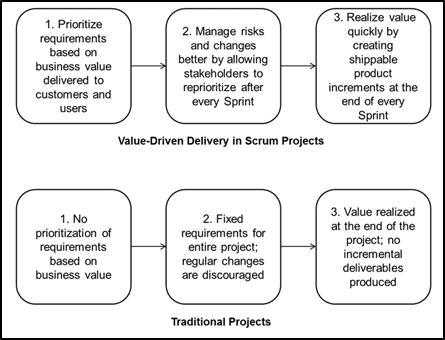
In Scrum projects, User Stories are ranked in order of priority which is an effective method for determining the desired User Stories for each iteration or release of the product or service. The purpose is to create a simple, single list with the goal of prioritizing features, rather than being distracted by multiple prioritization schemes.
This simple list also provides a basis for incorporating changes and identified risks when necessary. Each change or identified risk can be inserted in the list based on its priority relative to the other User Stories in the list. Typically, new changes will be included at the expense of features that have been assigned a lower priority.
Minimum Marketable Features (MMF) are also defined, so that the first release or iteration happens as early as possible, leading to increased ROI.
What is SCRUM?
Scrum is one of the most popular agile methodologies. It is an adaptive, iterative, fast, flexible, and effective methodology designed to deliver significant value quickly and throughout a project. Scrum ensures transparency in communication and creates an environment of collective accountability and continuous progress. The Scrum framework, as defined in the SBOK™ Guide, is structured in such a way that it supports product and service development in all types of industries and in any type of project, irrespective of its complexity.
A key strength of Scrum lies in its use of cross-functional, self-organized, and empowered teams who divide their work into short, concentrated work cycles called Sprints.
Traditional project management emphasizes on conducting detailed upfront planning for the project with emphasis on fixing the scope, cost and schedule - and managing those parameters. Whereas, Scrum encourages data-based, iterative decision making in which the primary focus is on delivering products that satisfy customer requirements.
To deliver the greatest amount of value in the shortest amount of time, Scrum promotes prioritization and Time-boxing over fixing the scope, cost and schedule of a project. An important feature of Scrum is self-organization, which allows the individuals who are actually doing the work to estimate and take ownership of tasks.